Newer
Japanese Onomatopoeia ②: Sound Words Like 「ザーザー」, 「ドンドン」, and 「リンリン」
24/05/2026
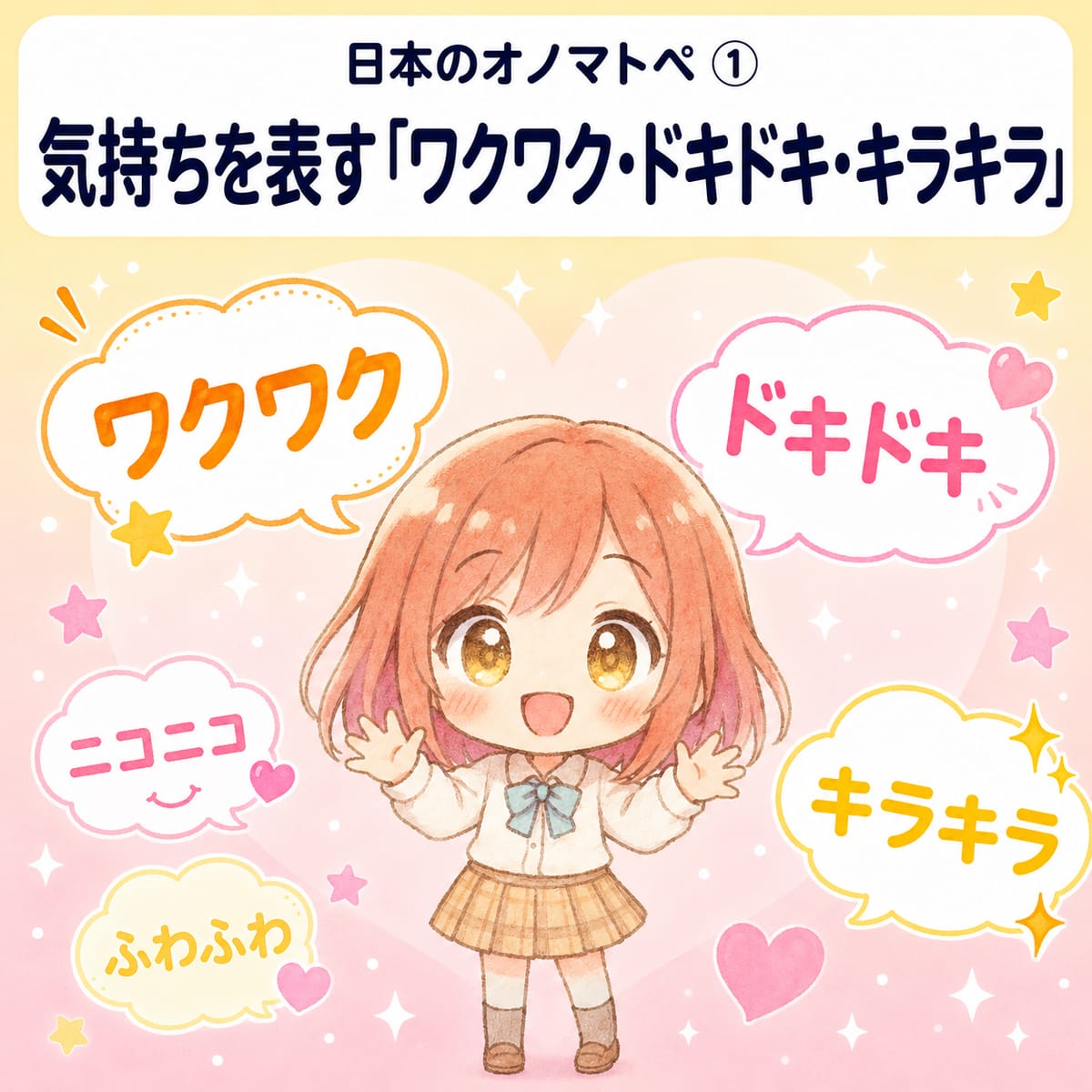
Japanese has many simple sound-like words that express feelings and states. These are called 「オノマトペ」 [o̞no̞mato̞pe̞], a Japanese term for sound-symbolic words such as onomatopoeia and mimetic expressions.
These words appear almost every day in conversation, anime, songs, and advertisements. Today, we choose seven onomatopoeic words that express feelings, and learn when to use them and how they are different, with examples.
「オノマトペ」 is a word that turns sounds or states into language. Japanese has two broad types.
| Type | What it shows | Example |
|---|---|---|
| 「擬音語」(ぎおんご) [ɡʲio̞ŋɡo̞]: words that turn sounds into language | sounds that can actually be heard | 「ワンワン」(a dog's bark), 「ザーザー」(heavy rain) |
| 「擬態語」(ぎたいご) [ɡʲitaiɡo̞]: words that turn states into language | states and feelings | 「ワクワク」(happy anticipation), 「キラキラ」(a sparkling look or feeling) |
Today's theme is 「擬態語」 words that express feelings. Even when there is no real sound, these words describe movement in the heart as if it were a sound.
First, let us look at the list.
| Word | Feeling it expresses | In one line |
|---|---|---|
| 「ワクワク」 | enjoyment, expectation | a lively feeling that something good is about to happen |
| 「ドキドキ」 | nervousness, fluttering excitement | a feeling as if your heart is beating fast |
| 「ハラハラ」 | worry | a restless feeling because you are worried whether things will go well |
| 「イライラ」 | anger, frustration when things do not go your way | a feeling of getting annoyed or being in a bad mood |
| 「ニコニコ」 | smiling, being in a good mood | a gentle smiling expression |
| 「キラキラ」 | a shining or sparkling look | a feeling that stars, eyes, or something else looks bright |
| 「ふわふわ」 | lightness, restlessness | a soft, light feeling like clouds or bread, or a feeling of not being settled |
Now let us look at each word in a little more detail.
Meaning: A happy, lively feeling when you are looking forward to something.
Use it when something good seems likely to happen, or when you are excited about what is about to begin. It is used only for positive feelings.
Examples:
Usage tip: It is often used in the forms 「ワクワクする」 and 「ワクワクしている」.
Meaning: A feeling as if your heart is beating fast. It can mean nervousness, or a fluttering feeling in front of someone you like.
The key feature is that it can be used for both 「こわい」 or 「不安」 feelings and 「うれしい」 or 「すき」 feelings. The meaning changes with the scene.
Examples:
Difference from 「ワクワク」: 「ワクワク」 is only about looking forward to something enjoyable. 「ドキドキ」 can also include nervousness, fear, or romance.
Meaning: A worried, restless feeling while watching whether something will go well.
It is often used when you are worried while watching another person or situation, rather than about yourself directly.
Examples:
Difference from 「ドキドキ」: 「ドキドキ」 is the feeling of your own heart beating fast. 「ハラハラ」 is the feeling of anxiously watching over someone or something.
Meaning: A feeling of becoming annoyed or being in a bad mood because things are not going as you want.
Use it when things do not move the way you want, such as when a train does not come, you are waiting for someone, or you cannot say something well.
Examples:
Caution: This expresses a strong feeling, so saying 「あなたにイライラする」 to someone directly can easily sound rude. Use it carefully.
Meaning: Being in a good mood and smiling gently.
Unlike laughing aloud as in 「ハハハ」, this word describes quietly keeping a smile on your face.
Examples:
Usage tip: It is used in expressions such as 「ニコニコする」, 「ニコニコ顔」, and 「ニコニコしている」.
Meaning: Looking bright, shiny, or sparkling. It can also describe a bright and energetic impression.
It can be used for both objects and feelings. It describes the light of eyes, stars, jewels, and also a happy expression or positive feeling.
Examples:
Usage tip: It is used in expressions such as 「キラキラ光る」 and 「キラキラした〇〇」.
Meaning: A light and soft state. It can also describe a restless, ungrounded feeling.
It can be used for both the feel of objects, such as softness, and the feel of emotions, such as not being settled.
Examples:
For feelings: It is used when you are so happy that you cannot settle down, or when something still does not feel real.
Feeling words in 「オノマトペ」 often use common patterns.
| Pattern | Example | Explanation |
|---|---|---|
| repeat the same sound twice | 「ワクワク」, 「ドキドキ」, 「ハラハラ」 | the most common form; it has a good rhythm |
| add 「〜する」 to make a verb | 「ワクワクする」, 「イライラする」 | expresses movement in the feeling |
| use 「〜している」 to show a state | 「ニコニコしている」, 「キラキラしている」 | expresses an ongoing state |
| use 「〜した〇〇」 to describe a noun in more detail | 「キラキラした目」, 「ふわふわしたパン」 | describes the state of a thing or person |
If you remember these four patterns, you will be able to use many 「オノマトペ」 words.
These words are useful for gently saying how you feel now.
Compared with saying 「うれしいです」 or 「きんちょうしています」, these words make your feelings sound more vivid.
You can also describe other people or things just as you see them.
When you use 「オノマトペ」, you can describe something visually with short words.
「オノマトペ」 is useful, but there are a few points to be careful about.
| Caution | Explanation |
|---|---|
| casual impression | do not overuse it in business email or formal documents |
| strong feeling | using 「イライラ」 towards another person can easily sound rude |
| difference in meaning | words may look similar but have different viewpoints, as in 「ドキドキ」(your own feeling) and 「ハラハラ」(your feeling while watching someone else) |
| can sound childish | if used too much, it may sound a little childish in business |
It is safe to remember this: use these words freely in conversation, diaries, and social media, but use fewer of them in formal situations.
| Fits | Does not fit |
|---|---|
| when sharing feelings in conversation with friends | public documents and contracts |
| when you want to write vividly on social media or in a diary | academic papers and business reports, especially if overused |
| expressions in anime, manga, and songs | when strongly blaming the other person, such as with 「イライラする」 |
| conversations with children and family | formal conversations with people you are meeting for the first time |
Here are feeling words in 「オノマトペ」 with kana readings and approximate IPA. They are easier to remember if you pay attention to the rhythm, such as the four beats in 「ワ・ク・ワ・ク」.
| Word | Feeling it expresses | Example | Reading (kana(かな(ひらがなよみ))) | Pronunciation (IPA) | Function |
|---|---|---|---|---|---|
| 「ワクワク」 | enjoyment, expectation | 「旅行が楽しみでワクワクする。」 (I am excited about the trip.) | (わくわく) | [wakɯ̥wakɯ̥] | positive expectation |
| 「ドキドキ」 | nervousness, fluttering excitement | 「試験の前にドキドキする。」 (I feel nervous before the exam.) | (どきどき) | [do̞kido̞ki] | a feeling that the heart beats fast |
| 「ハラハラ」 | worry, restlessness | 「子どもを見ていてハラハラする。」 (I feel worried watching the child.) | (はらはら) | [haɾahaɾa] | worry while watching someone or something |
| 「イライラ」 | bad mood, things not going your way | 「電車がおそくてイライラした。」 (I got annoyed because the train was slow.) | (いらいら) | [iɾaiɾa] | an unpleasant feeling when things do not go your way |
| 「ニコニコ」 | good mood, smile | 「先生はニコニコしている。」 (The teacher is smiling.) | (にこにこ) | [niko̞niko̞] | a quiet smile that continues |
| 「キラキラ」 | sparkle, hope | 「星がキラキラ光る。」 (The stars sparkle.) | (きらきら) | [kiɾakiɾa] | a shining or hopeful state |
| 「ふわふわ」 | lightness, restlessness | 「パンがふわふわでおいしい。」 (The bread is soft and tasty.) | (ふわふわ) | [ɸɯwaɸɯwa] | softness or a feeling that something does not feel real yet |
IPA is approximate. Vowel length and the vowels in 「ク」 and 「キ」 may sound weak or devoiced. Check together with kana.
Let us see which 「オノマトペ」 sounds natural in each scene.
| Scene | Intention | Better wording | Reading (kana(かな(ひらがなよみ))) | Pronunciation (IPA) | Point |
|---|---|---|---|---|---|
| Daily life (holiday) | looking forward to a trip | 「旅行が楽しみで、ワクワクしています。」 (I am excited about the trip.) | (りょこう が たのしみ で わくわく しています) | [ɾʲo̞koː ɡa tano̞ɕimi de̞ wakɯ̥wakɯ̥ ɕite̞imasɯ] | positive expectation |
| Daily life (family) | worried about a child | 「高い所にのぼる子を見て、ハラハラした。」 (I felt worried watching the child climb up high.) | (たかい ところ に のぼる こ を みて はらはら した) | [takai to̞ko̞ɾo̞ ni no̞bo̞ɾɯ ko̞ o̞ mite̞ haɾahaɾa ɕita] | worry while watching another person |
| School (exam) | feeling nervous | 「発表の前は、ドキドキします。」 (I feel nervous before the presentation.) | (はっぴょう の まえ は どきどき します) | [happʲo̞ː no̞ mae̞ wa do̞kido̞ki ɕimasɯ] | the feeling of your own heart beating fast |
| School (friends) | a friend looks happy | 「友だちはニコニコしながら話していた。」 (My friend was talking with a smile.) | (ともだち は にこにこ しながら はなしていた) | [to̞mo̞datɕi wa niko̞niko̞ ɕinaɡaɾa hanaɕite̞ita] | observe and describe someone's state |
| Work (break) | wanting to stay in a good mood | 「朝はコーヒーを飲んで、ニコニコ仕事を始めます。」 (In the morning, I drink coffee and start work with a smile.) | (あさ は こーひー を のんで にこにこ しごと を はじめます) | [asa wa ko̞ːhiː o̞ no̞nde̞ niko̞niko̞ ɕiɡo̞to̞ o̞ hadʑime̞masɯ] | light expression, usable even at work |
| Work (waiting) | frustrated because there is no reply | 「返事が来なくて、少しイライラしてしまった。」 (I got a little irritated because there was no reply.) | (へんじ が こなくて すこし いらいら して しまった) | [he̞ndʑi ɡa ko̞nakɯ̥te̞ sɯ̥ko̞ɕi iɾaiɾa ɕite̞ ɕimatta] | say it as your own feeling, not directly at the other person |
「ドキドキする」 shows the movement of the feeling now, while 「ドキドキしている」 shows an ongoing state.
Choose based on whether the feeling is a short event or an ongoing state.
If you use two 「オノマトペ」 words together, the feeling becomes easier to understand.
The rhythm is good, so it sounds natural in conversation.
In business or formal situations, rephrasing 「オノマトペ」 can sound more refined.
It is also useful to switch to more natural Japanese depending on the situation.
| Common sentence | What is the issue? | Fix (example) |
|---|---|---|
| 「今日はワクワクをしました。」 | 「ワクワクする」 is the verb form. 「を」 is not needed. | 「今日はワクワクしました。」 |
| 「雨がワクワク降っています。」 | 「ワクワク」 is a feeling. It is not used for the sound of things. | 「雨がザーザー降っています。」 |
| Saying 「イライラします」 directly to your boss | it sounds strong and can be rude | use another expression such as 「少し気になっています」 |
| 「パンがニコニコしている。」 | 「ニコニコ」 describes a person's smile | 「パンがふわふわしている。」 |
Feeling words in 「オノマトペ」 are easier to organise by feeling category:
The key points are:
Once you can use 「オノマトペ」, your Japanese sounds much more vivid. Start with one favourite word from the seven you learnt today, and try using it every day.
Next time, in Japanese Onomatopoeia ②, we will look at 「オノマトペ」 words that express sounds. We will learn the fun of turning real sounds into words, such as rain going 「ザーザー」, a door going 「バタン」, and a heart going 「ドキン」. Look forward to it.