Newer
Japanese Onomatopoeia ④: Movement and Walking Words Like 「テクテク」, 「ピョンピョン」, and 「ノロノロ」
16/06/2026
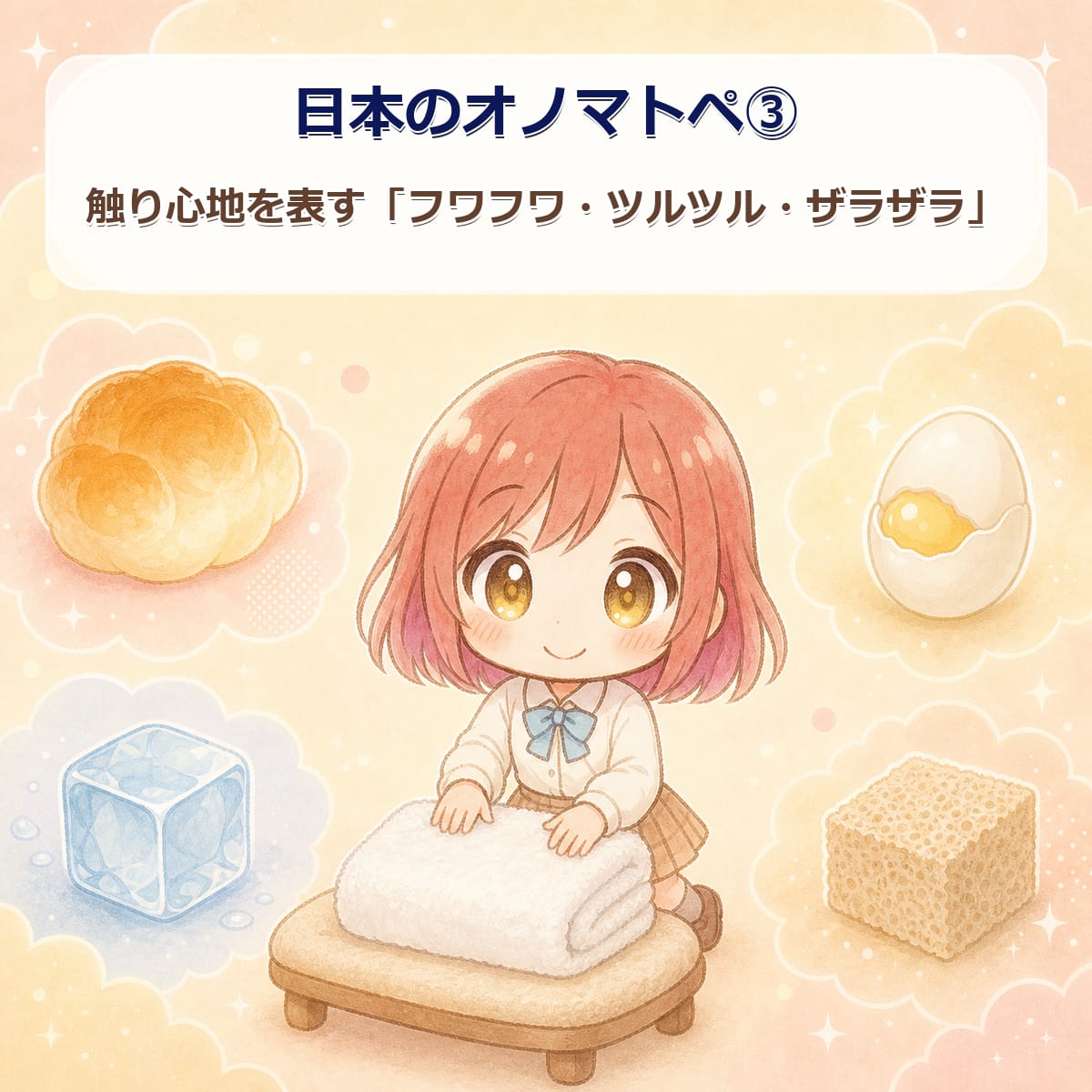
In the earlier articles on 「オノマトペ」 [o̞no̞mato̞pe̞], Japanese sound-symbolic words, we learnt:
This time, we look at one more very common group.
These are words that express how something feels when you touch it.
You do not actually hear a sound with these words. Because they express the feeling when you touch something, they are called 「擬態語」(ぎたいご) [ɡʲitaiɡo̞], words that turn states, feelings, and textures into language. They appear often in daily conversation about food, shopping, clothes, and weather.
Today, we choose eight texture words in 「オノマトペ」 that are common in daily life, and learn what each one feels like and how to use it, with examples.
There are two main types of 「オノマトペ」. Let us review them from the previous article.
| Type | What it shows | Example |
|---|---|---|
| 「擬音語」(ぎおんご) [ɡʲio̞ŋɡo̞]: words that turn sounds into language | sounds that can actually be heard | 「ザーザー」(rain sound), 「ドンドン」(hitting sound) |
| 「擬態語」(ぎたいご) [ɡʲitaiɡo̞]: words that turn states into language | states, feelings, and sensations, with no actual sound | 「ワクワク」(happy anticipation), 「フワフワ」(a soft feeling) |
Texture does not make a sound. So all the words in today's article are 「擬態語」.
They turn what the body feels into words, such as touching with your hand, feeling something on your skin, or noticing a texture inside your mouth.
First, let us look at the list.
| Word | What kind of feeling? | In one line |
|---|---|---|
| 「フワフワ」 | soft and light | bread, clouds, towels |
| 「ツルツル」 | smooth and slippery | ice, a smooth floor, boiled eggs |
| 「ザラザラ」 | finely rough | sandpaper, sand, dry skin |
| 「サラサラ」 | dry and smooth | hair, fine dry sand, cloth |
| 「ベタベタ」 | sticky and clinging | honey, sweat, sweets |
| 「モチモチ」 | soft and springy | rice cake, bread, a baby's skin |
| 「フカフカ」 | soft and puffy | futons, sofas, snow |
| 「チクチク」 | prickly, as if small points touch the skin | sweaters, beard stubble, dry grass |
Now let us look at each word in a little more detail.
Meaning: A soft and light feeling. It gives the image of something holding a lot of air.
Use it for soft and pleasant things, such as bread, towels, clouds, and hair.
Examples:
Usage tip: It can be used not only for things, but also for feelings. 「気持ちがフワフワする。」 means you feel unsettled or not grounded.
Meaning: A surface is smooth and easy to slip on. There are no bumps.
Use it for ice, boiled eggs, a floor polished until smooth, smooth skin, and similar things.
Examples:
Caution: 「ツルツルすべる。」 can also mean that something is dangerous. When you use it for ice or a wet floor, it becomes a warning.
Meaning: A surface has many small bumps and feels rough. It is the opposite of 「ツルツル」.
Use it for sandpaper, sand, dry and rough skin, and similar things.
Examples:
Usage tip: 「ザラザラ」 is often used for a texture that does not feel pleasant. It is also useful when talking about skin that is not in good condition.
Meaning: Dry, smooth, and flowing easily. It is not sticky.
Use it for hair, fine dry sand, smooth cloth, the flow of water, and similar things.
Examples:
Difference from 「ザラザラ」: 「サラサラ」 feels smooth and pleasant, while 「ザラザラ」 feels finely rough and catches a little. The sounds are similar, but the textures are opposite.
Meaning: Sticky and clinging. It sticks to your hands or to things.
Use it for sticky and unpleasant things, such as honey, sweets, sweat, and glue.
Examples:
Usage tip: It can also describe relationships between people. 「ベタベタする。」 can mean two people are always clinging to each other and are overly close. This is casual wording.
Meaning: Soft and elastic, with a springy feeling that comes back a little when pressed.
Use it for 「もち」(もち) [mo̞tɕi], Japanese rice cake, bread, 「うどん」(うどん) [ɯdo̞ɴ], thick wheat noodles, a baby's skin, and similar things.
Examples:
Usage tip: For food, 「モチモチ」 is often used as praise. You will often see it on restaurant menus and in advertisements.
Meaning: Soft, puffy, and pleasant to sink into when you press it.
Use it for 「ふとん」(ふとん) [ɸɯto̞ɴ], Japanese bedding, sofas, piled-up snow, fresh bread, and similar things.
Examples:
Difference from 「フワフワ」: 「フワフワ」 is light and soft, while 「フカフカ」 is soft, thick, and sinks when pressed. 「フカフカ」 fits futons and sofas well.
Meaning: A feeling as if small sharp things lightly prick the skin.
Use it for wool sweaters, beard stubble, dry grass, small thorns, and similar things.
Examples:
Usage tip: 「チクチク」 can also be used for the heart. 「胸がチクチクする。」 expresses a feeling of slight pain or guilt.
| Pattern | Example | Explanation |
|---|---|---|
| repeat the same sound twice | 「フワフワ」, 「ツルツル」, 「ザラザラ」 | the most common form; it gives the image that the feeling continues |
| add 「〜の」 to connect to a noun | 「フワフワのパン」, 「サラサラの髪」 | natural when describing what a thing is like |
| add 「〜する」 to make a verb | 「ベタベタする」, 「チクチクする」 | expresses a texture or state |
| use 「〜だ/です」 to finish the sentence | 「このもちはモチモチだ。」 | easily gives an impression or evaluation |
Texture words in 「オノマトペ」 are often used to express food texture, or how something feels in your mouth. In Japan, texture is important in food, so these words often appear on menus and in cooking programmes.
When you talk about food, adding a texture word along with taste makes your impression more vivid.
Texture words in 「オノマトペ」 are also common in daily life.
They are useful when shopping too, especially when you want to describe the feel of clothes or towels.
| Word | Feeling | Easily confused word | Difference |
|---|---|---|---|
| 「フワフワ」 | light and soft | 「フカフカ」 | 「フカフカ」 has thickness and sinks when pressed |
| 「ツルツル」 | smooth and slippery | 「サラサラ」 | 「サラサラ」 is dry and flowing |
| 「ザラザラ」 | finely rough and catching | 「サラサラ」 | the sounds are similar, but the textures are opposite |
| 「ベタベタ」 | sticky and clinging | 「ヌルヌル」 | 「ヌルヌル」 is watery and slippery |
| 「モチモチ」 | springy | 「フワフワ」 | 「フワフワ」 focuses more on lightness than springiness |
| Fits | Does not fit |
|---|---|
| when describing food texture | public documents and reports, especially if overused |
| when talking about clothes, towels, and skin | business emails, where they can sound a little childish |
| conversations with friends and family | academic papers and legal documents |
| social media, diaries, and shop menus | formal self-introductions with someone you are meeting for the first time |
| Word | What kind of feeling? | Example | Reading (kana(かな(ひらがなよみ))) | Pronunciation (IPA) | Usage point |
|---|---|---|---|---|---|
| 「フワフワ」 | soft and light | 「パンがフワフワだ。」 (The bread is soft and fluffy.) | (ふわふわ) | [ɸɯwaɸɯwa] | focuses on lightness and softness |
| 「ツルツル」 | smooth and slippery | 「道がツルツルすべる。」 (The road is slippery.) | (つるつる) | [tsɯɾɯtsɯɾɯ] | no bumps; easy to slip |
| 「ザラザラ」 | finely rough | 「紙がザラザラする。」 (The paper feels rough.) | (ざらざら) | [zaɾazaɾa] | opposite of 「ツルツル」 |
| 「サラサラ」 | dry and smooth | 「髪がサラサラだ。」 (The hair is smooth.) | (さらさら) | [saɾasaɾa] | dry and flowing |
| 「ベタベタ」 | sticky and clinging | 「手がベタベタする。」 (My hands feel sticky.) | (べたべた) | [betabeta] | sticky and unpleasant |
| 「モチモチ」 | springy | 「パンがモチモチだ。」 (The bread is chewy and springy.) | (もちもち) | [mo̞tɕimo̞tɕi] | soft and returns when pressed |
| 「フカフカ」 | puffy and sinking | 「ふとんがフカフカだ。」 (The futon is soft and puffy.) | (ふかふか) | [ɸɯkaɸɯka] | thick and sinks when pressed |
| 「チクチク」 | prickly | 「セーターがチクチクする。」 (The sweater feels prickly.) | (ちくちく) | [tɕikɯtɕikɯ] | a feeling of thin things pricking the skin |
IPA is approximate. Vowel length and sounds such as 「ふ」 and 「つ」 can vary by speaker and region. Check together with kana.
| Scene | Intention | Better wording | Reading (kana(かな(ひらがなよみ))) | Pronunciation (IPA) | Point |
|---|---|---|---|---|---|
| Daily life (meal) | the bread is soft | 「このパン、フワフワでおいしいね。」 (This bread is soft and tasty.) | (この ぱん ふわふわ で おいしい ね) | [ko̞no̞ paɴ ɸɯwaɸɯwa de̞ o̞iɕiː ne̞] | a natural way to praise texture |
| Daily life (weather) | the road is slippery and dangerous | 「道がツルツルだから気をつけて。」 (The road is slippery, so be careful.) | (みち が つるつる だから きをつけて) | [mitɕi ɡa tsɯɾɯtsɯɾɯ dakaɾa kʲio̞tsɯ̥ke̞te̞] | a warning expression |
| Daily life (grooming) | the hair feels good | 「シャンプーしたら髪がサラサラ。」 (After shampooing, my hair is smooth.) | (しゃんぷー したら かみ が さらさら) | [ɕampɯː ɕitaɾa kami ɡa saɾasaɾa] | a pleasant texture |
| Daily life (summer) | sweat feels unpleasant | 「暑くて体がベタベタする。」 (It is hot, and my body feels sticky.) | (あつくて からだ が べたべた する) | [atsɯ̥kɯ̥te̞ kaɾada ɡa betabeta sɯɾɯ] | quickly expresses an unpleasant feeling |
| School (lunch) | impression of a lunch box | 「おもちがモチモチしておいしかった。」 (The rice cake was chewy and tasty.) | (おもち が もちもち して おいしかった) | [o̞mo̞tɕi ɡa mo̞tɕimo̞tɕi ɕite̞ o̞iɕikatta] | praises food texture |
| Work (sales service) | recommending a towel | 「こちらはフカフカで肌ざわりがよいです。」 (This one is soft and puffy, with a pleasant feel on the skin.) | (こちら は ふかふか で はだざわり が よい です) | [ko̞tɕiɾa wa ɸɯkaɸɯka de̞ hadazawaɾi ɡa jo̞i desɯ] | politely describes texture |
Texture words in 「オノマトペ」 can be written in hiragana or katakana.
The meaning is the same. Choose based on the scene and the feeling you want to show.
Texture words in 「オノマトペ」 become easier to organise if you learn them together with opposite feelings.
| One side | Opposite |
|---|---|
| 「ツルツル」(smooth) | 「ザラザラ」(rough) |
| 「サラサラ」(dry and smooth) | 「ベタベタ」(sticky) |
| 「フワフワ」 and 「フカフカ」(soft) | 「カチカチ」(hard) |
Some words express not only texture, but also feelings.
Judge the meaning from the flow of the sentence.
| Common sentence | What is the issue? | Fix (example) |
|---|---|---|
| 「ふとんがフワフワで、しずむ。」 | for a sinking feeling, a word with thickness fits better | 「ふとんがフカフカで、しずむ。」 |
| 「髪がツルツル流れる。」 | for smooth flowing hair, another word fits better | 「髪がサラサラ流れる。」 |
| 「紙やすりがサラサラしている。」 | 「サラサラ」 is smooth; it does not fit roughness | 「紙やすりがザラザラしている。」 |
| 「あめで手がサラサラになった。」 | it does not fit a sticky feeling | 「あめで手がベタベタになった。」 |
Texture words in 「オノマトペ」 become easier to organise by texture type:
The four key points are:
Once you can use texture words in 「オノマトペ」, you can describe food texture and the feel of things vividly in Japanese. Start with the eight words you learnt today, especially common words such as 「フワフワ」 and 「ツルツル」, and try using them in your own impressions.
Next time, in Japanese Onomatopoeia ④, we will look at 「オノマトペ」 words that express people's movements and ways of walking. We will see the fun of expressing body movement through sound-like words, such as 「テクテク」(walking), 「ぴょんぴょん」(jumping), and 「のろのろ」(slowly). Look forward to it.