Newer
Japanese Onomatopoeia ③: Texture and Touch Words with 「フワフワ・ツルツル・ザラザラ」
06/14/2026
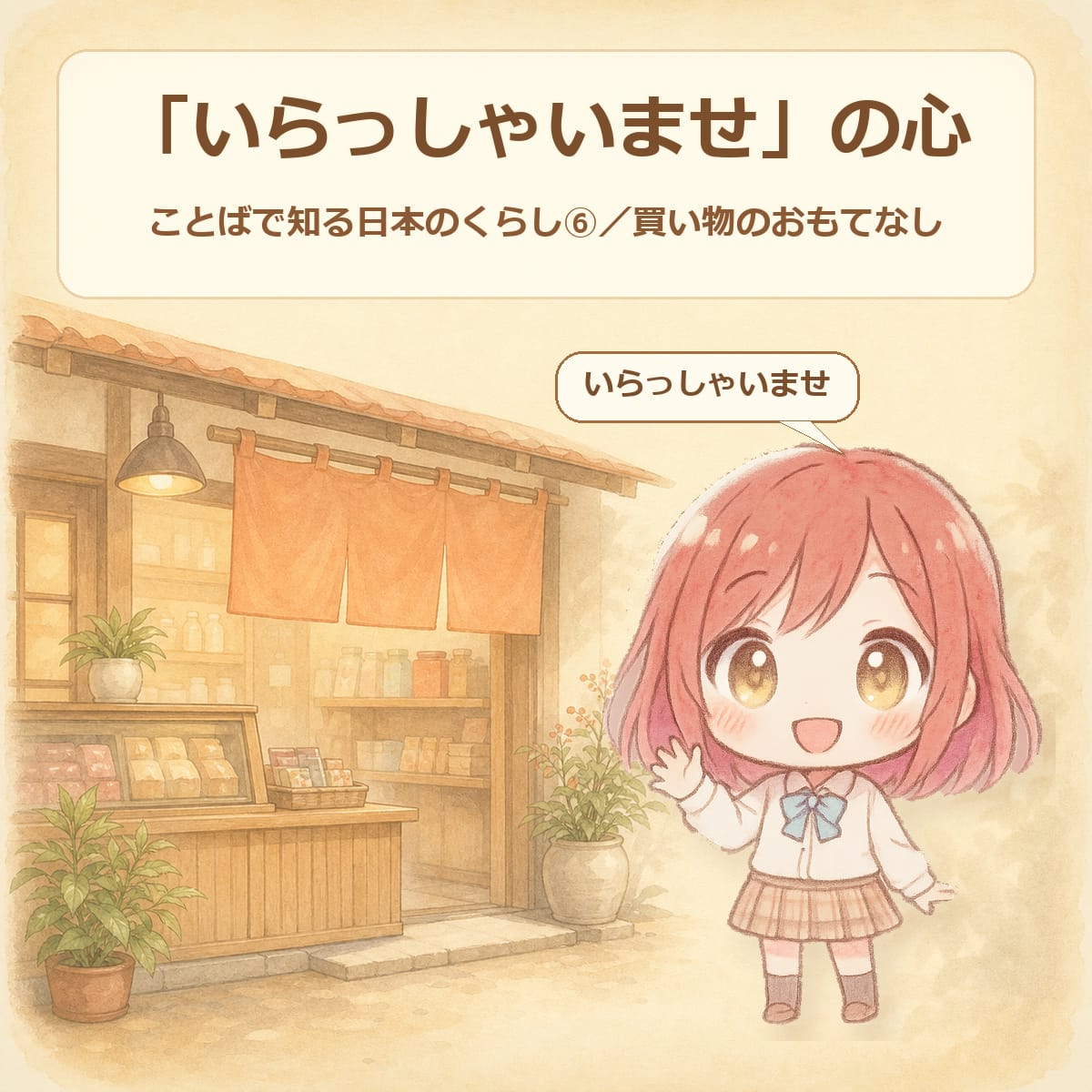
When you enter a shop in Japan, you often hear a bright voice saying 「いらっしゃいませ」 right away. Convenience stores, supermarkets, restaurants, clothing stores: in many places, this is the voice that warmly welcomes customers.
People visiting Japan for the first time often wonder, "What should I say back to 「いらっしゃいませ」?" The answer is very simple. You do not need to reply. A small bow called 「会釈(えしゃく) [eɕakɯ]」 is enough.
So why do shop staff speak so politely? Behind it is the Japanese spirit of 「おもてなし(おもてなし) [omotenaɕi]」: welcoming and caring for someone with sincerity, without expecting anything in return. In this article, we learn shopping phrases and the feeling behind them in clear learner-friendly English.
| Japanese | Reading (kana(かな(ひらがなよみ))) | IPA | Meaning & usage |
|---|---|---|---|
| 「いらっしゃいませ」 | (いらっしゃいませ) | [iɾaɕɕaimase] | A welcome greeting for customers entering a shop. No reply is needed. |
| 「おもてなし」 | (おもてなし) | [omotenaɕi] | Welcoming and caring for someone sincerely, without expecting anything in return. |
| 「少々お待ちください」 | (しょうしょうおまちください) | [ɕoːɕoː o maꜜtɕi kɯdasai] | A polite way to say "Please wait a moment." |
| 「お会計」 | (おかいけい) | [o kaikeː] | Payment at the register; paying money for what you buy. |
| 「ありがとうございました」 | (ありがとうございました) | [aɾiɡatoː ɡozaimaɕita] | A thank-you said to customers after shopping. |
| 「またのお越しをお待ちしております」 | (またのおこしをおまちしております) | [mata no okoɕi o omatɕi ɕite oɾimasɯ] | A very polite goodbye meaning "We hope you will come again." |
IPA is a learning guide. Sounds may change a little by region and speaking style.
「おもてなし」 is a word that represents Japanese service culture. It means taking care of guests or customers with sincerity so they can feel comfortable.
The important point is that it does not ask for something in return, such as a tip or a gift. In Japan, even when a shop gives polite service, customers do not leave a tip. Even so, staff greet customers with a smile and wrap products carefully.
This spirit connects with 「思いやり(おもいやり) [omoijaɾi]」, the consideration for others that we studied in article 5 of this series. You think about the other person and want them to feel comfortable. That feeling appears in words and behavior.
「いらっしゃいませ」 is a sign of thanks to the customer. It is not rude if you do not reply. A light nod is enough to show that you have received the greeting.
Customer-service language often uses special polite expressions. They may sound a little difficult, but if you know the forms, shopping becomes much easier.
「少々」 is a polite way to say 「少し」. Staff use it when they look for a product or check something. It means 「少しだけ待ってください。」.
Example: 「こちらでよろしいでしょうか。」 This is a very polite form of 「いいですか。」 Staff use it when checking something with a customer. You can answer with 「はい、お願いします。」.
Example: 「お待ちしております。」 This is a polite form of 「〜しています。」 Staff use it when speaking very politely about their own side.
Example: 「お会計はこちらでお願いします。」 and 「お受け取りください。」 This form makes a request to a customer sound softer.
As a customer, you do not need to say these expressions yourself. It is enough to understand them when you hear them. When you answer, 「はい。」, 「お願いします。」, or 「ありがとう。」 will usually work.
Customer service in shops differs by country and region. When you know the differences, the special features of Japan become easier to see.
Cultural differences are not about good or bad. Every culture has its own way of caring for customers.
Scene: You buy a drink and pay at the register.
− Clerk: 「いらっしゃいませ。」 − (The customer gives a small bow and places the item at the register.) − Clerk: 「お会計は150円です。」 − Customer: 「はい、お願いします。」 − Clerk: 「ありがとうございました。またお越しください。」 − Customer: 「どうも。」
| Expression | Point |
|---|---|
| 「いらっしゃいませ。」 | A welcome greeting. No reply is needed. |
| 「お願いします。」 | A useful short phrase when asking for payment or a procedure to be handled. |
| 「どうも。」 | A light way to say "thanks." You can use it when leaving a shop. |
Shop expressions are polite, so they can sometimes feel a little difficult. If you rephrase the meaning into easy Japanese, they become clearer.
Polite forms are used in shops, but the meaning is simple. If you first change them into easy Japanese, they become easier to remember.
Next time: "Learning About Life in Japan Through Words (7)." Theme idea: 「お風呂(おふろ) [oɸɯɾo]」, home baths, and 「銭湯(せんとう) [seɴtoː]」, public bathhouses, and words for Japan's 「きれい好き(きれいずき) [kiɾeːzɯki]」, the idea of liking cleanliness.