Newer
Japanese Onomatopoeia ⑥: Feeling and Mind-State Words 「イライラ・ソワソワ・ニコニコ」
28/06/2026
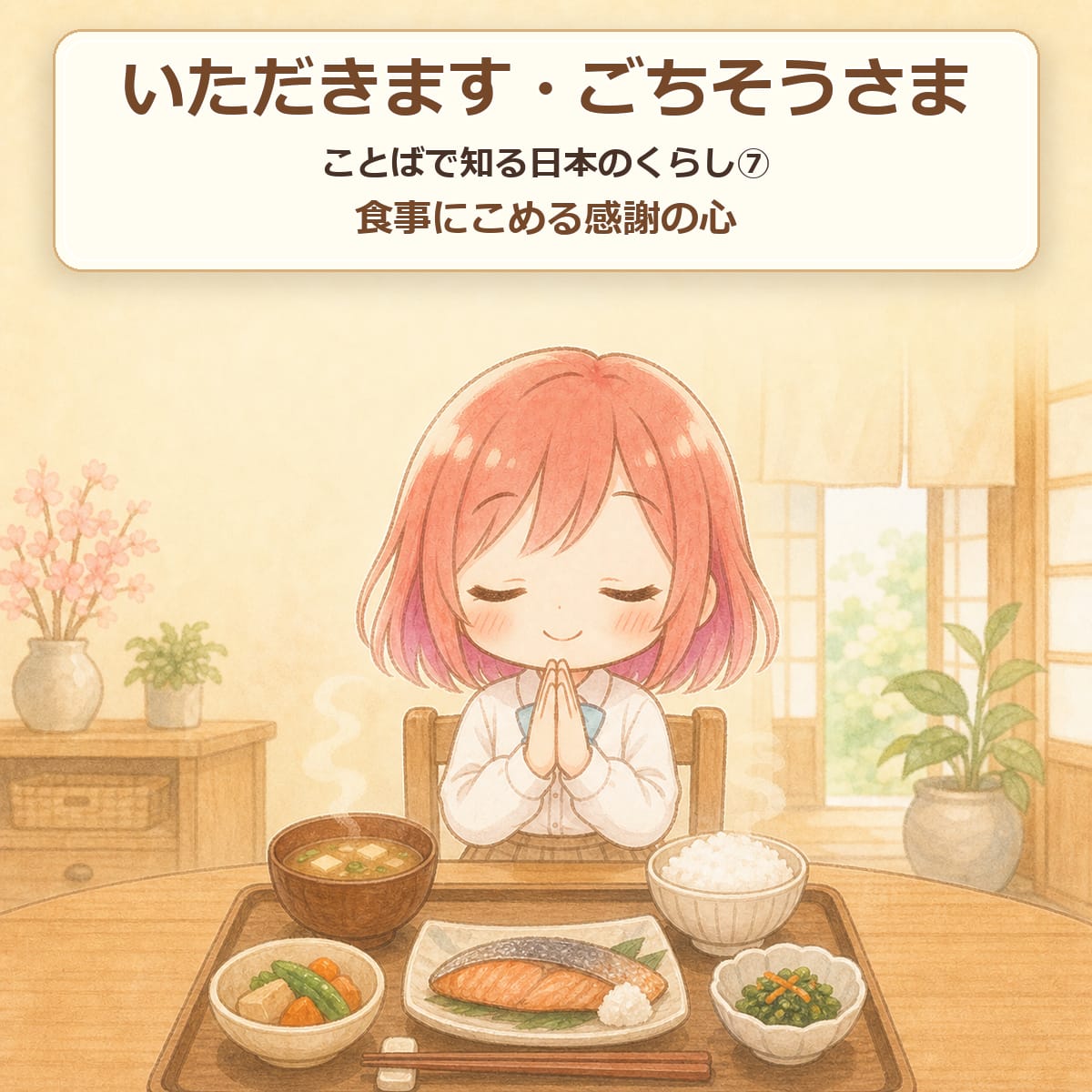
In Japan, people say 「いただきます」(いただきます /itadakimasɯ/, a greeting said before eating) before a meal. After finishing the meal, they say 「ごちそうさま(でした)」(ごちそうさまでした /ɡotɕisoːsama deɕita/, a thank-you said after eating). You will often hear these two phrases at home, at school, and in restaurants.
If you come to Japan for the first time, you may wonder: 「だれに向かって言っているの?」(Who are they saying it to?) or 「言わないと、失礼なの?」(Is it rude if I do not say it?)
The answer is in this article. Today, while learning mealtime greetings in simple Japanese, let us look at the 「感謝(かんしゃ)の心」(feeling of gratitude) behind these words.
| Japanese | Reading | IPA | Meaning and use |
|---|---|---|---|
| 「いただきます」 | 「いただきます」 | [itadakimasɯ] | A greeting said before a meal. It carries the feeling: “I am grateful for the life in the food and for the people who made it.” |
| 「ごちそうさまでした」 | 「ごちそうさまでした」 | [ɡotɕisoːsama deɕita] | A greeting said after a meal. It means “that was delicious, thank you”. |
| 「いただく」 | 「いただく」 | [itadakɯ] | A humble way to say “receive” or “eat”. |
| 「命」 | 「いのち」 | [inotɕi] | Life; being alive. The life of animals and plants. |
| 「感謝」 | 「かんしゃ」 | [kaɴɕa] | The feeling of being thankful. |
| 「もったいない」 | 「もったいない」 | [mottainai] | The feeling that it is a shame to waste something that can still be used. |
IPA is a learning guide. The sound can change a little depending on region and speaking style.
「いただきます」 is not just a signal that eating is starting. It carries a deep feeling of gratitude.
Everything we eat was once 「命(いのち)」(life). Meat, fish, rice, and vegetables were all living things. We receive that life into our own bodies as 「いただく」(to humbly receive or eat).
That is why 「いただきます」 expresses two kinds of thanks.
The farmer who grew the rice, the fisher who caught the fish, and the family member or shop staff who cooked the meal. Thanks to many people, the food is in front of you. 「いただきます」 is a word that says “thank you” to all of them.
When saying 「いただきます」, many people put both hands together in front of the chest. This gesture shows gratitude. However, it is not rude if you do not do it. It differs by family and region.
These two greetings have interesting origins. When you understand the meaning, they become easier to remember.
「いただく」 is a humble way to say 「もらう」(receive) or 「食べる」(eat). In the past, people received important things from someone above them, or from a deity, by raising them above the head, called 「いただき」(top of the head). That verb became a mealtime word. In other words, it means 「(あなたの命を)ありがたく受け取ります。」(I gratefully receive this life.)
「ごちそう」 is written in kanji as 「御馳走」. 「馳走(ちそう)」 means “running around”. Long ago, people ran here and there to gather food and prepare a meal for guests. The thanks for that effort became 「ごちそうさま」. It carries the feeling: 「わたしのために、走り回ってくれてありがとう。」(Thank you for running around for me.)
Before a meal, say 「いただきます」. After a meal, say 「ごちそうさま(でした)」. Learn the before-and-after pair together.
Many learners ask, “who is this said to?” Let us look at different situations.
| Scene | What to say | Point |
|---|---|---|
| When eating alone at home | 「いただきます」/「ごちそうさま」 | Even if nobody is there, you can say it quietly. It is gratitude for the food. |
| When eating with family | 「いただきます」/「ごちそうさまでした」 | If you say it towards the person who cooked, your feeling comes across more clearly. |
| School lunch(「給食(きゅうしょく)」) | everyone says 「いただきます」 | Often said by the whole class after the signal from the day duty student, called 「日直(にっちょく)」(class duty student). |
| At a restaurant | 「(小さな声で)いただきます」 | You do not need to say it loudly to the staff. It is for yourself and the people eating with you. |
| At a friend's house | 「ごちそうさまでした。」 | If you thank the family who cooked for you clearly, they will be pleased. |
In short, there is no fixed person you must say it to. It is a natural greeting of gratitude towards the life in the food and everyone connected with the meal.
Greetings before and after meals differ by country and culture. When you compare them, the special features of Japan become easier to see.
Cultural differences are not about good or bad. Every culture has a heart that values food and the people involved.
Scene: Your friend's mother has made dinner.
− Mother: 「さあ、できましたよ。どうぞ。」(Here you are. Please go ahead.) − You: 「わあ、おいしそう! いただきます。」(Wow, it looks delicious! I will eat now, thank you.) −(After eating) − You: 「とてもおいしかったです。ごちそうさまでした。」(It was very tasty. Thank you for the meal.) − Mother: 「お粗末(そまつ)さまでした。たくさん食べてね。」(It was nothing special. Please eat plenty.)
| Expression | Point |
|---|---|
| 「いただきます。」 | Greeting before eating. Putting your hands together makes it polite. |
| 「ごちそうさまでした。」 | Thanks after eating. The person who cooked will be pleased if you say it clearly. |
| 「お粗末(そまつ)さまでした。」 | A humble reply from the person who cooked, meaning “it was nothing special”. |
A word connected to gratitude for food is 「もったいない」(もったいない /mottainai/, the feeling that wasting something usable is regrettable).
「もったいない」 is the feeling that it is a shame to throw away food when it can still be eaten. Because we have received life, we try to eat without leaving food if we can. In Japan, many people are taught this from childhood.
「いただきます」, 「ごちそうさま」, and 「もったいない」 all come from the same heart: valuing the life in food.
When mealtime words are rewritten in 「やさしい日本語」(やさしい にほんご /jasaɕiː nihoŋɡo/, simple Japanese for easier communication), their meaning becomes easy to understand.
Mealtime words that sound difficult have simple meanings. Remember that the feeling of “thank you” is at the centre.
Next time: 「ことばで知る日本のくらし⑧」(Learning About Life in Japan Through Words ⑧). Theme idea: learning words for Japan's 「きれい好き」(love of cleanliness) through 「お風呂(おふろ)」(bath) and 「銭湯(せんとう)」(public bath).