Older
Learning About Life in Japan Through Words ⑦: 「いただきます」 and 「ごちそうさま」 ─ The gratitude held in a meal
22/06/2026
In the previous onomatopoeia lessons, we learnt:
This time, we will expand the feeling words we learnt in Part ①.
These words turn many different states of the heart, such as being angry, restless, relieved, or disappointed, into language.
Feeling onomatopoeia is very useful for briefly showing what is happening inside your own heart or another person's heart. You will see and hear it everywhere: in conversation, on social media, in manga, and in dramas. If you learn today's words, you will be able to express feelings more naturally.
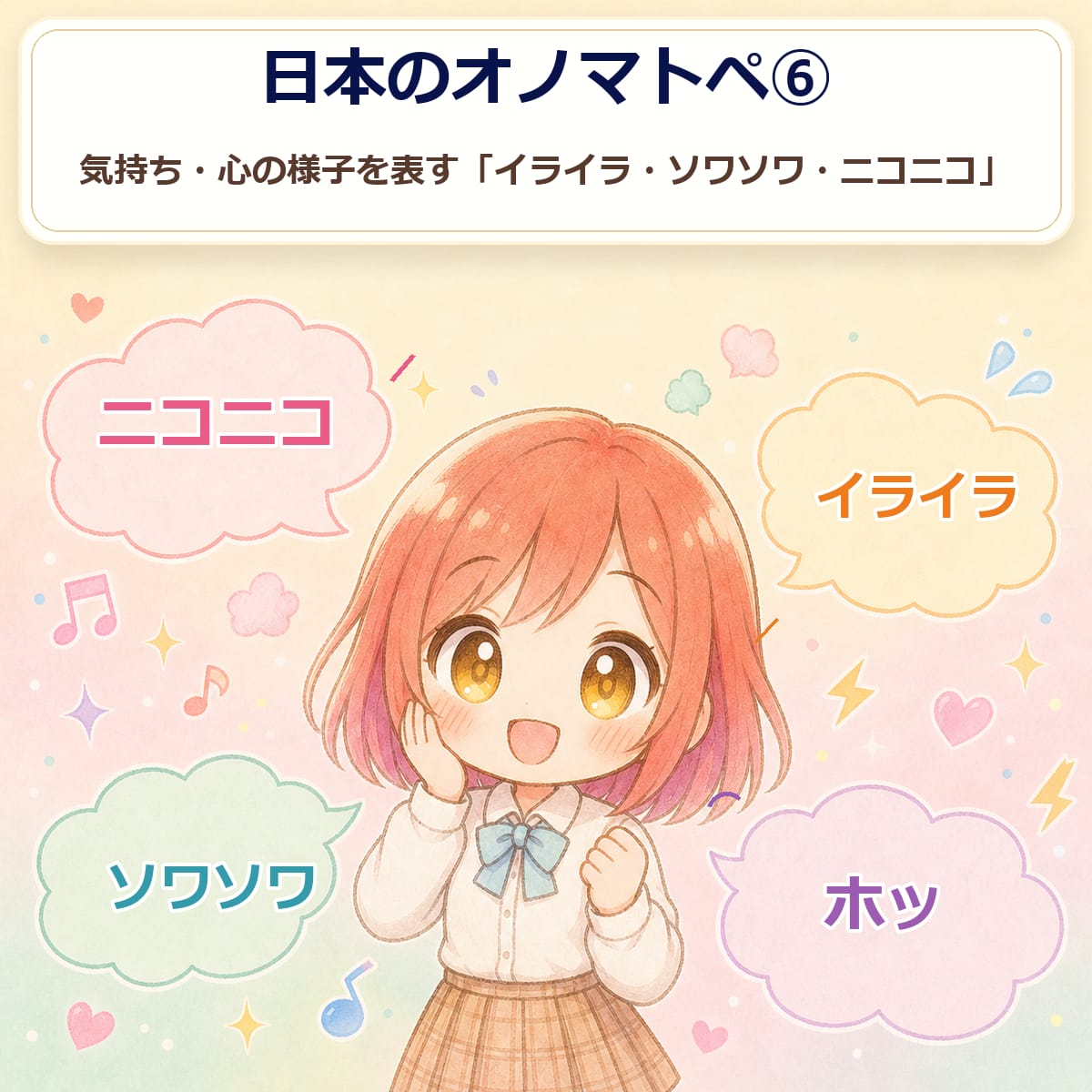
Today, we will study eight sound-symbolic words for feelings and states of mind. For each one, we will look at what kind of feeling it shows and how to use it, with examples.
Japanese sound-symbolic words, called 「オノマトペ」(おのまとぺ /o̞no̞mato̞pe̞/, words that imitate sounds or express states), have two main types. Let us quickly review what we learnt before.
| Type | What it represents | Examples |
|---|---|---|
| 「擬音語」(ぎおんご /ɡioŋɡo/, sound-imitating words): words that turn sounds into language | Sounds you can actually hear | 「ザーザー」(rain sound), 「ドンドン」(knocking or banging sound) |
| 「擬態語」(ぎたいご /ɡitaigo/, state-describing words): words that turn states into language | States and feelings (without an actual sound) | 「イライラ」(being angry or annoyed), 「ニコニコ」(smiling) |
Most feeling onomatopoeia is 「擬態語」.
If you notice whether a sound can be heard or the word describes a feeling or state, it becomes easier to remember the meaning. You can think of feeling onomatopoeia as words that describe states of the heart.
First, let us see the list. The first half is for "not-so-good feelings", and the second half is for "good feelings and relief".
| Word | Group | In short |
|---|---|---|
| 「イライラ」 | Not-so-good feeling | Angry or annoyed |
| 「ソワソワ」 | Restless | Worried or excited, and unable to stay calm |
| 「ハラハラ」 | Worry | So worried that you cannot relax |
| 「クヨクヨ」 | Negative thinking | Worrying again and again about something |
| 「ガッカリ」 | Disappointment | Feeling down because something did not meet your hopes |
| 「ニコニコ」 | Good feeling | Smiling happily |
| 「ウキウキ」 | Good feeling | Happy and excited, with a light heart |
| 「ホッと」 | Relief | Feeling relieved after tension goes away |
Let us look at each word in a little more detail.
Meaning: A feeling of becoming angry or annoyed because things are not going the way you want. The feeling is sharp and unsettled.
Use it when you have been made to wait, when something is not going well, or when something is noisy.
Example sentences:
Usage tip: 「イライラ」 is a not-so-good feeling. It is often used in the forms 「イライラする」 and 「イライラした」. If you say 「イライラしないで」(Do not get irritated) to someone, it can work as gentle encouragement.
Meaning: A state where something is on your mind and your heart cannot settle. It is the feeling of not being able to stay still.
Use it before something important, when you are waiting for something good, or when you have something to worry about.
Example sentences:
Difference from 「イライラ」: 「イライラ」 is an angry or annoyed feeling, while 「ソワソワ」 is a restless feeling. 「ソワソワ」 can be used for good things (excitement) and bad things (worry).
Meaning: A state of being very worried that something bad may happen. It is often used to describe the feeling of a person who is watching.
Use it when watching a sports match, a dangerous situation, or a scene in a drama.
Example sentences:
Usage tip: 「ハラハラ」 is often used when you are worried while watching another person or a situation, rather than about yourself. If 「ドキドキ」 is the sound-like feeling of your own heartbeat, 「ハラハラ」 is the feeling of watching anxiously.
Meaning: A state of worrying for a long time about something that is already over. It is a negative feeling where you keep thinking about a small thing again and again.
Use it after a mistake or after something unpleasant has happened.
Example sentences:
Note: 「クヨクヨ」 shows a not-so-good feeling. 「クヨクヨしないで」(Do not keep worrying) is often used as kind encouragement when you want someone to feel better.
Meaning: A state where your hopes do not come true, and your feeling drops. It gives the image of losing energy because you are disappointed.
Use it when something you were looking forward to is cancelled, or when things do not go as expected.
Example sentences:
Usage tip: 「ガッカリ」 is used in the forms 「ガッカリする」 and 「ガッカリした」. It is also often written in hiragana as 「がっかり」. It is a word with the image of your feelings "going down".
Meaning: A state of smiling gently and happily. It feels like smiling with your facial expression, without making a loud sound.
Use it when someone is happy, pleased, or in a good mood.
Example sentences:
Difference between 「ニコニコ」 and 「ニヤニヤ」: 「ニコニコ」 is a bright and pleasant smile. The similar word 「ニヤニヤ」 is used when someone is smiling while hiding something, and it can have a bad impression. For a pleasant smile, use 「ニコニコ」.
Meaning: A state where your heart feels light and excited because something happy or fun is coming. The feeling is bright and light.
Use it when you have enjoyable plans or when something good is waiting for you.
Example sentences:
Difference from 「ソワソワ」: Both describe the feeling of waiting for something in the future, but 「ウキウキ」 is happy and positive, while 「ソワソワ」 is restless. 「ウキウキ」 is used only for good feelings.
Meaning: A state of feeling relieved after worry or tension goes away. It is often used in the form 「ホッとする」.
Use it when a problem ends safely or when a worry disappears.
Example sentences:
Usage tip: 「ホッと」 comes from 「ほっ」, the sound-like feeling of letting out a breath you were holding. The expression 「ホッと一息(ひといき)つく」(to take one relieved breath) is also common. It is a very useful word for showing a relieved feeling.
| Form | Example | Explanation |
|---|---|---|
| Repeating the same sound twice | 「イライラ」, 「ニコニコ」, 「ウキウキ」 | The most common form. It gives the image that the feeling continues. |
| Adding 「〜する」 to make it a verb | 「イライラする」, 「ニコニコする」 | Shows a state or movement of the heart. This use is very common. |
| Using 「〜している」 to show the current state | 「ソワソワしている」, 「ニコニコしている」 | Tells what the person is like now. |
| Using 「〜した」 to show a change of feeling | 「ホッとした」, 「ガッカリした」 | Shows the moment when the feeling changed. |
| Adding 「〜と」 before a verb | 「ホッと安心する」, 「ニコニコと笑う」 | Natural when you want to describe the state in detail. |
A key feature of feeling onomatopoeia is that it very often uses the form with 「〜する」.
Feeling onomatopoeia is very useful for briefly showing what is inside your heart. Even without a long explanation, the feeling comes across quickly.
Compared with only saying "happy" or "I do not like it", these words explain what kind of feeling you have in more detail. They are used very often in conversations with family and friends.
Feeling onomatopoeia is also common in social media posts and manga. Because it expresses feelings in short words, readers can easily imagine the situation.
In manga, words like 「イライラ」 and 「ニコニコ」 are often written next to a character to show their feeling. If you know feeling onomatopoeia, you can enjoy manga and dramas more.
| Word | Feeling | Easily confused with | Difference |
|---|---|---|---|
| 「イライラ」 | Angry or annoyed | 「ソワソワ」 | 「ソワソワ」 is only restless (not angry) |
| 「ソワソワ」 | Restless | 「ウキウキ」 | 「ウキウキ」 is happy and positive |
| 「ハラハラ」 | Worried while watching | 「ドキドキ」 | 「ドキドキ」 is the sound-like feeling of your own heartbeat |
| 「クヨクヨ」 | Worrying negatively | 「ガッカリ」 | 「ガッカリ」 is the moment when your hopes do not come true |
| 「ニコニコ」 | Bright smile | 「ニヤニヤ」 | 「ニヤニヤ」 is a smile that may be hiding something |
| Good situations | Not-so-good situations |
|---|---|
| Conversations with friends and family | Official documents or reports (avoid using too many) |
| Writing feelings on social media | Academic papers or very formal announcements |
| Talking about impressions of manga or dramas | Formal business meeting minutes |
| Gently expressing your own feelings | Formal self-introductions when meeting someone for the first time |
| Word | What kind of feeling? | Example sentence | Reading(かな(ひらがなよみ)) | Pronunciation(IPA) | Usage point |
|---|---|---|---|---|---|
| 「イライラ」 | Angry or annoyed | 「電車が来なくてイライラする。」(The train is not coming, so I feel annoyed.) | 「いらいら」 | [iɾaiɾa] | Not-so-good feeling |
| 「ソワソワ」 | Restless | 「試験の前でソワソワする。」(I feel restless before the exam.) | 「そわそわ」 | [so̞waso̞wa] | Good things and bad things |
| 「ハラハラ」 | Worried while watching | 「試合をハラハラして見る。」(Watch the match nervously.) | 「はらはら」 | [haɾahaɾa] | Worrying about a person or situation |
| 「クヨクヨ」 | Worrying negatively | 「しっぱいをクヨクヨ考える。」(Keep worrying about a mistake.) | 「くよくよ」 | [kɯjo̞kɯjo̞] | Often used in encouragement |
| 「ガッカリ」 | Feeling disappointed | 「中止になってガッカリした。」(It was cancelled, and I was disappointed.) | 「がっかり」 | [ɡakkaɾi] | Feeling goes down |
| 「ニコニコ」 | Smiling happily | 「赤ちゃんがニコニコ笑う。」(The baby smiles happily.) | 「にこにこ」 | [nʲiko̞nʲiko̞] | Bright and pleasant smile |
| 「ウキウキ」 | Heart feels excited | 「旅行の前でウキウキする。」(I feel excited before the trip.) | 「うきうき」 | [ɯkʲiɯkʲi] | Happy and positive |
| 「ホッと」 | Feeling relieved | 「終わってホッとした。」(It ended, and I felt relieved.) | 「ほっと」 | [ho̞tto̞] | Tension goes away |
IPA is approximate. Vowel length and sounds such as 「っ」 can change depending on the speaker and region. Check them together with the kana reading.
| Scene | What you want to say | Natural expression | Reading(かな(ひらがなよみ)) | Pronunciation(IPA) | Point |
|---|---|---|---|---|---|
| Daily life (waiting time) | I am annoyed | 「電車が来なくてイライラするね。」(The train is not coming, and it is annoying.) | 「でんしゃ が こなくて いらいら する ね」 | [de̞ɲɕa ɡa ko̞nakɯ̥te̞ iɾaiɾa sɯɾɯ ne̞] | Not-so-good feeling |
| Daily life (looking forward to something) | My heart feels excited | 「明日の旅行、ウキウキするね。」(Tomorrow's trip feels exciting.) | 「あした の りょこう うきうき する ね」 | [aɕita no̞ ɾʲo̞ko̞ː ɯkʲiɯkʲi sɯɾɯ ne̞] | Positive feeling |
| Daily life (relief) | The tension has gone away | 「ぶじに着いてホッとしたよ。」(I arrived safely, and I felt relieved.) | 「ぶじ に ついて ほっと した よ」 | [bɯʑi ni tsɯite̞ ho̞tto̞ ɕita jo̞] | When you feel relieved |
| School (encouragement) | I want someone to feel better | 「クヨクヨしないで、次がんばろう。」(Do not keep worrying. Let us try again next time.) | 「くよくよ しないで つぎ がんばろう」 | [kɯjo̞kɯjo̞ ɕinaide̞ tsɯɡʲi ɡambaɾo̞ː] | Gentle encouragement |
| Work (waiting) | I cannot stay calm | 「返事を待っていてソワソワします。」(I am waiting for the reply and feel restless.) | 「へんじ を まっていて そわそわ します」 | [he̞ndʑi o̞ matte̞ite̞ so̞waso̞wa ɕimasɯ̥] | Can also be used politely |
| Work (disappointment) | I feel disappointed | 「中止になってガッカリしました。」(It was cancelled, and I was disappointed.) | 「ちゅうし に なって がっかり しました」 | [tɕɯːɕi ni natte̞ ɡakkaɾi ɕimaɕita] | Polite expression of disappointment |
Feeling onomatopoeia can be written in hiragana or katakana.
The meaning is the same. Choose by situation and feeling. Katakana is often used when you want to show the feeling strongly.
Today's words become easier to organise if you divide them into two groups.
| Group | Words |
|---|---|
| Good feelings and relief | 「ニコニコ」, 「ウキウキ」, 「ホッと」 |
| Not-so-good feelings | 「イライラ」, 「クヨクヨ」, 「ガッカリ」 |
| Restlessness and worry | 「ソワソワ」, 「ハラハラ」 |
Feeling onomatopoeia can be put into a sentence simply by adding 「〜する」.
If you first remember the 「〜する」 form, you can use these words in conversation right away.
| Common sentence | What is the problem? | Fix (example) |
|---|---|---|
| 「楽しみで、朝からイライラする。」 | 「イライラ」 is an angry feeling | 「楽しみで、朝からソワソワする。」 |
| 「終わってイライラした。」 | Relief is 「ホッと」 | 「終わってホッとした。」 |
| 「中止になってウキウキした。」 | Disappointment is 「ガッカリ」 | 「中止になってガッカリした。」 |
| 「しっぱいをニコニコ考える。」 | Worrying negatively is 「クヨクヨ」 | 「しっぱいをクヨクヨ考える。」 |
Feeling and mind-state onomatopoeia becomes easier to organise when you group it by type of feeling:
The four key points are:
Once you can use feeling onomatopoeia, you can express your own heart and another person's heart vividly in Japanese. Start with common words from today's eight, such as 「イライラ」, 「ニコニコ」, and 「ホッと」, and try using them in your next conversation.
Next time, in Japanese Onomatopoeia ⑦, we will look at sound-symbolic words that describe the state or condition of things. We will study expressions that put the condition of things around us into words, such as 「ピカピカ」(shiny), 「ボロボロ」(old and worn out), and 「ぐちゃぐちゃ」(messy). Please look forward to it.