Newer
Japanese Onomatopoeia ⑤: Eating and Food Texture Words with 「パクパク・モグモグ・ペコペコ」
06/18/2026
In the previous onomatopoeia articles, we learned:
This time, we will look at one more very common group.
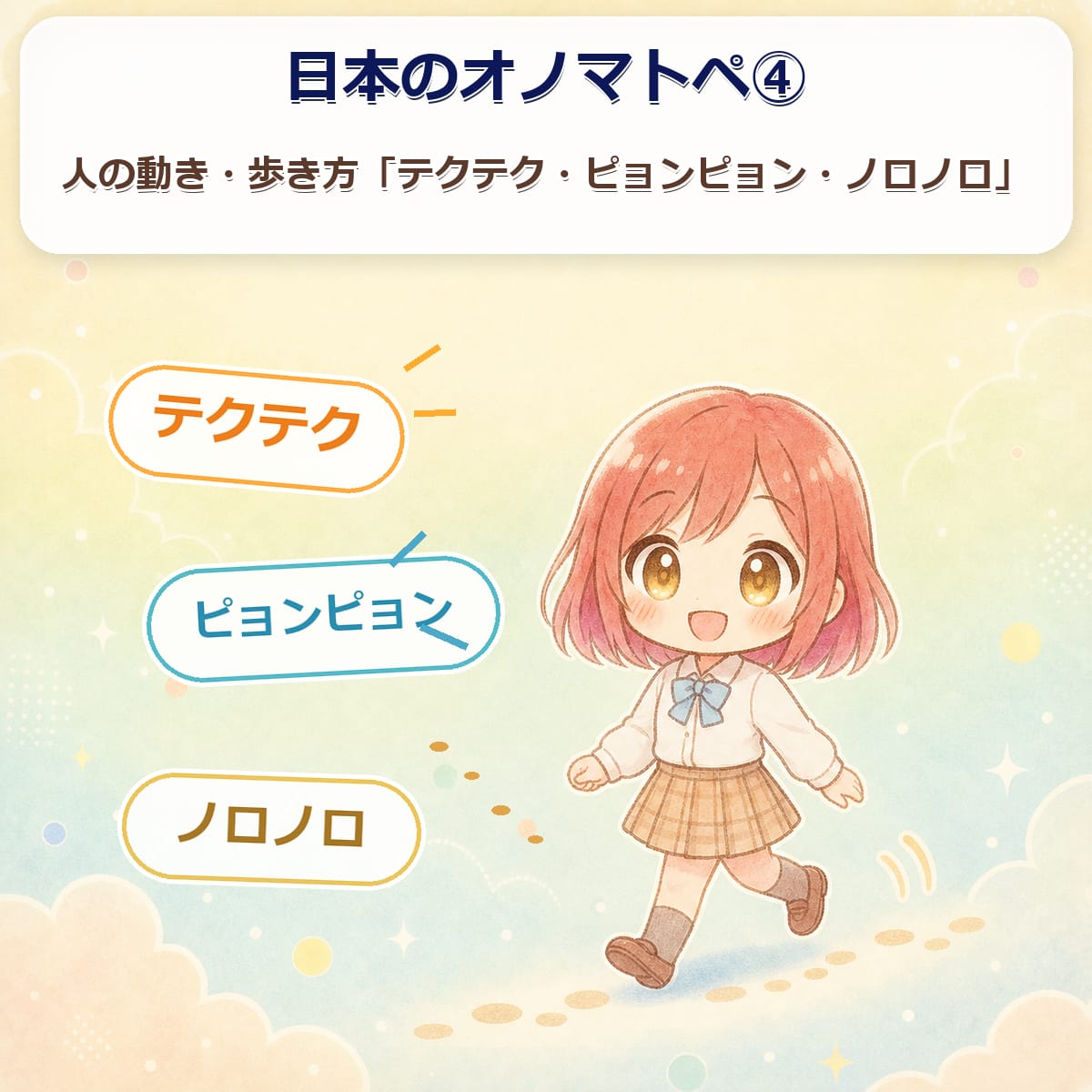
These are words that put people's movements and ways of walking into language.
These are not sounds you hear. Because they express how something is moving, they are called 「擬態語(ぎたいご) [ɡʲitaiɡo̞]」, mimetic words. They appear not only in conversation, but also in stories, picture books, and manga.
Today, we will learn eight movement and walking onomatopoeic words that are common in daily life, with examples showing what kind of movement they express and how to use them.
Japanese onomatopoeia has two main types. Let's review them from the previous article.
| Type | What it expresses | Examples |
|---|---|---|
| 「擬音語(ぎおんご) [ɡʲio̞ɴɡo̞]」: words that turn sounds into language | Sounds you can actually hear | 「ザーザー(雨の音)」 (sound of heavy rain), 「ドンドン(たたく音)」 (knocking or banging sound) |
| 「擬態語(ぎたいご) [ɡʲitaiɡo̞]」: words that turn states into language | States, feelings, and movements without sound | 「ワクワク(楽しみ)」 (excited anticipation), 「テクテク(歩く様子)」 (walking steadily) |
Ways of walking and moving usually do not make a sound. For that reason, all of today's words are 「擬態語」.
They turn how fast, with what feeling, and in what manner someone is moving into words.
First, let's look at the list.
| Word | What kind of movement? | In one short phrase |
|---|---|---|
| 「テクテク」 | continuing to walk at a steady speed | walking a long way with energy |
| 「スタスタ」 | walking fast and briskly | walking in a hurry |
| 「トボトボ」 | walking slowly without energy | walking sadly |
| 「ノロノロ」 | moving very slowly | so slow it can feel frustrating |
| 「ピョンピョン」 | hopping lightly again and again | rabbits and children |
| 「ヨロヨロ」 | unsteady and about to fall | unsafe footing |
| 「ウロウロ」 | going back and forth without a clear purpose | lost or restless |
| 「ヨチヨチ」 | walking awkwardly with small steps | how a baby walks |
Now let's look at each one in more detail.
Meaning: Walking continuously at about the same speed without stopping. It is especially used when walking a long distance.
Use it when someone walks steadily at a normal speed, such as walking to the station or to a destination.
Examples:
Usage hint: 「テクテク」 has an energetic and positive image. It does not sound dangerous or painful. It simply shows that someone is walking steadily.
Meaning: Walking fast and briskly. The steps feel efficient and purposeful.
Use it for walking when someone is in a hurry or has a clear purpose.
Examples:
Difference from 「テクテク」: 「テクテク」 is a relaxed, normal speed. 「スタスタ」 is faster and more brisk. The speed and sense of hurry are different.
Meaning: Walking slowly with no energy, often while looking down. It shows a lonely, tired, or disappointed feeling.
Use it after someone has been scolded, after a failure, or when someone is tired.
Examples:
Usage hint: 「トボトボ」 carries emotion. More than walking speed, it communicates a lonely or downhearted feeling.
Meaning: Moving very slowly. Progress is poor, and people watching may feel frustrated.
Use it not only for people's movements, but also for cars and the progress of work.
Examples:
Caution: 「ノロノロ」 includes a slightly negative feeling. It can mean that something is slow in an inconvenient way, so be careful when saying it directly to a person.
Meaning: Hopping lightly again and again. It fits movements by rabbits, children, frogs, and similar subjects.
It is also used for happy or energetic movement.
Examples:
Usage hint: If you say only 「ピョン」 once, it means one jump or hop, as in 「カエルがピョンととんだ。」 (A frog hopped once). When you repeat it, it shows repeated hopping.
Meaning: Walking unsteadily, as if about to fall. The body or legs do not have enough strength.
Use it when someone is tired, unwell, or carrying something heavy.
Examples:
Caution: 「ヨロヨロ」 describes an unsafe state. When using it about an older person or someone who is unwell, use it together with a feeling of concern.
Meaning: Going back and forth around the same area without a clear purpose. It gives a restless feeling.
Use it when someone is lost, looking for something, or waiting.
Examples:
Usage hint: 「ウロウロ」 describes movement without a clear purpose. It can sometimes look suspicious, so when explaining yourself, adding a reason such as 「道にまよって」 (because I got lost) can make the situation clearer.
Meaning: A baby or small child walking awkwardly and unsteadily.
It is often used for a baby who has just started walking. It has a cute, affectionate feeling.
Examples:
Usage hint: The phrase 「ヨチヨチ歩き」 can also be used like a noun. It can refer to the stage when a child has just started walking.
| Form | Examples | Explanation |
|---|---|---|
| Repeat the same sound twice | 「テクテク」、「スタスタ」、「ノロノロ」 | The most common form. It gives the image that the movement continues. |
| Add 「〜と」 to connect to a verb | 「テクテクと歩く」、「ピョンピョンととぶ」 | Natural when explaining a movement in detail. |
| Add 「〜する」 to make a verb | 「ノロノロする」、「ウロウロする」 | Expresses a movement or state. |
| Say it only once | 「ピョンととぶ」 | Shows a single movement. |
Movement onomatopoeia is useful for briefly explaining who moved and how. Even without a long explanation, the situation becomes easy to imagine.
Compared with only saying that someone walked or went home, these words also communicate the feeling and manner at the same time.
Movement onomatopoeia is very common inside stories. It helps readers feel as if they can see the characters moving.
When you read Japanese picture books or manga, you will see many movement onomatopoeic words. Once you understand them, the story becomes more enjoyable.
| Word | Movement | Easily confused word | Difference |
|---|---|---|---|
| 「テクテク」 | walking at a normal speed | 「スタスタ」 | 「スタスタ」 is fast and brisk |
| 「スタスタ」 | walking fast | 「ノロノロ」 | 「ノロノロ」 is very slow, the opposite |
| 「トボトボ」 | walking without energy | 「ヨロヨロ」 | 「ヨロヨロ」 means the feet are unsteady and unsafe |
| 「ウロウロ」 | moving without a clear purpose | 「ノロノロ」 | 「ノロノロ」 means slow; 「ウロウロ」 means without a purpose |
| 「ヨチヨチ」 | walking awkwardly | 「ヨロヨロ」 | 「ヨチヨチ」 is for babies; 「ヨロヨロ」 is unsteady walking |
| Fits | Does not fit |
|---|---|
| Conversation with friends and family | Public documents and reports, especially if overused |
| Talking about children or animals | Business email, where it can sound a little childish |
| Stories, picture books, and diaries | Academic papers and legal documents |
| Social media posts about daily events | Formal self-introductions with people you have just met |
| Word | What kind of movement? | Example | Reading(「かな(ひらがなよみ)」) | Pronunciation (IPA) | Usage point |
|---|---|---|---|---|---|
| 「テクテク」 | continuing to walk at a normal speed | 「駅までテクテク歩く。」 (I walk steadily to the station.) | (てくてく) | [te̞kɯ̥te̞kɯ̥] | Walking with steady energy |
| 「スタスタ」 | walking fast and briskly | 「スタスタ歩いて行く。」 (They walk away briskly.) | (すたすた) | [sɯ̥tasɯ̥ta] | Hurried, efficient steps |
| 「トボトボ」 | walking without energy | 「トボトボ家に帰る。」 (I walk home dejectedly.) | (とぼとぼ) | [to̞bo̞to̞bo̞] | Lonely and downhearted |
| 「ノロノロ」 | moving very slowly | 「ノロノロ進む。」 (It moves very slowly.) | (のろのろ) | [no̞ɾo̞no̞ɾo̞] | Slow and frustrating |
| 「ピョンピョン」 | hopping lightly | 「ピョンピョンとぶ。」 (It hops around.) | (ぴょんぴょん) | [pʲo̞mpʲo̞ɴ] | Hopping or happy movement |
| 「ヨロヨロ」 | unsteady and unsafe | 「ヨロヨロ歩く。」 (They walk unsteadily.) | (よろよろ) | [jo̞ɾo̞jo̞ɾo̞] | Weak and unsafe |
| 「ウロウロ」 | going back and forth without a clear purpose | 「前でウロウロする。」 (They wander around in front.) | (うろうろ) | [ɯɾo̞ɯɾo̞] | No clear purpose and restless |
| 「ヨチヨチ」 | walking awkwardly | 「ヨチヨチ歩く。」 (A baby toddles.) | (よちよち) | [jo̞tɕijo̞tɕi] | How a baby walks |
IPA is approximate. Vowel length and sounds such as 「つ」 and 「ち」 vary by speaker and region. Check them together with kana.
| Scene | Intention | Natural wording | Reading(「かな(ひらがなよみ)」) | Pronunciation (IPA) | Point |
|---|---|---|---|---|---|
| Daily life (commuting or school) | You walked to the station | 「駅までテクテク歩いたよ。」 (I walked steadily to the station.) | (えき まで てくてく あるいた よ) | [e̞ki made̞ te̞kɯ̥te̞kɯ̥ aɾɯita jo̞] | A normal walking situation |
| Daily life (in a hurry) | You left quickly | 「時間がなくてスタスタ出た。」 (I had no time, so I left quickly.) | (じかん が なくて すたすた でた) | [dʑikaɴ ɡa nakɯ̥te̞ sɯ̥tasɯ̥ta de̞ta] | Hurried steps |
| Daily life (children) | A baby started walking | 「赤ちゃんがヨチヨチ歩き出した。」 (The baby started toddling.) | (あかちゃん が よちよち あるきだした) | [akatɕaɴ ɡa jo̞tɕijo̞tɕi aɾɯkidaɕita] | A cute, affectionate image |
| Daily life (health) | Someone feels unwell | 「熱でヨロヨロしている。」 (They are unsteady because of a fever.) | (ねつ で よろよろ して いる) | [ne̞tsɯ̥ de̞ jo̞ɾo̞jo̞ɾo̞ ɕite̞ iɾɯ] | Unsafe and worrying |
| School (message) | You got lost at a meeting place | 「駅前でウロウロしてました。」 (I was wandering around in front of the station.) | (えきまえ で うろうろ して ました) | [e̞kimae̞ de̞ ɯɾo̞ɯɾo̞ ɕite̞ maɕita] | Adding a reason makes it clearer |
| Work (soft warning) | Work is moving slowly | 「少しノロノロしているようです。」 (It seems to be moving a little slowly.) | (すこし のろのろ して いる よう です) | [sɯ̥ko̞ɕi no̞ɾo̞no̞ɾo̞ ɕite̞ iɾɯ jo̞ː desɯ̥] | A softer, less direct wording |
Movement onomatopoeia can be written in both hiragana and katakana.
The meaning is the same. Choose based on the situation and the feeling you want to give.
Movement onomatopoeia becomes easier to organize when you learn it together with opposite states.
| One side | Opposite |
|---|---|
| 「スタスタ(速い)」 (fast) | 「ノロノロ(おそい)」 (slow) |
| 「テクテク(元気に歩く)」 (walking with energy) | 「トボトボ(元気なく歩く)」 (walking without energy) |
| walking steadily | 「ヨロヨロ・ヨチヨチ(足どりがあぶない)」 (unsafe footing) |
Movement onomatopoeia expresses not only speed, but also feeling.
When you choose the word by imagining the feeling, it becomes easier to find the right one.
| Common sentence | What is the issue? | Fix (example) |
|---|---|---|
| 「急いでいるので、ノロノロ歩いた。」 | 「ノロノロ」 is slow. It does not fit being in a hurry. | 「急いでいるので、スタスタ歩いた。」 |
| 「赤ちゃんがスタスタ歩きはじめた。」 | A baby who has just started walking is still unsteady. | 「赤ちゃんがヨチヨチ歩きはじめた。」 |
| 「うれしくてトボトボした。」 | 「トボトボ」 shows a lonely or sad feeling. | 「うれしくてピョンピョンはねた。」 |
| 「元気いっぱいヨロヨロ歩いた。」 | 「ヨロヨロ」 means unsafe or weak, not energetic. | 「元気いっぱいテクテク歩いた。」 |
Onomatopoeia for people's movements and ways of walking becomes easier to learn when you group it by type:
The four key points are:
Once you can use movement onomatopoeia, you can describe the movements of people and animals vividly in Japanese. Start with common words such as 「テクテク」 and 「ノロノロ」, and try using them for real events in your own life.
Next time, in Japanese Onomatopoeia ⑤, we will cover onomatopoeia for eating and drinking. We will look at words often used in mealtime situations, such as 「パクパク(よく食べる)」 (eating eagerly), 「ゴクゴク(いきおいよく飲む)」 (drinking in big gulps), and 「モグモグ(口を動かしてかむ)」 (chewing with the mouth moving). Please look forward to it.