Newer
Learning About Life in Japan Through Words (7) 「いただきます」 and 「ごちそうさま」 ─ The Gratitude Held in Meals
06/22/2026
In the previous onomatopoeia articles, we learned:
This time, we will look at the group closest to everyday life.
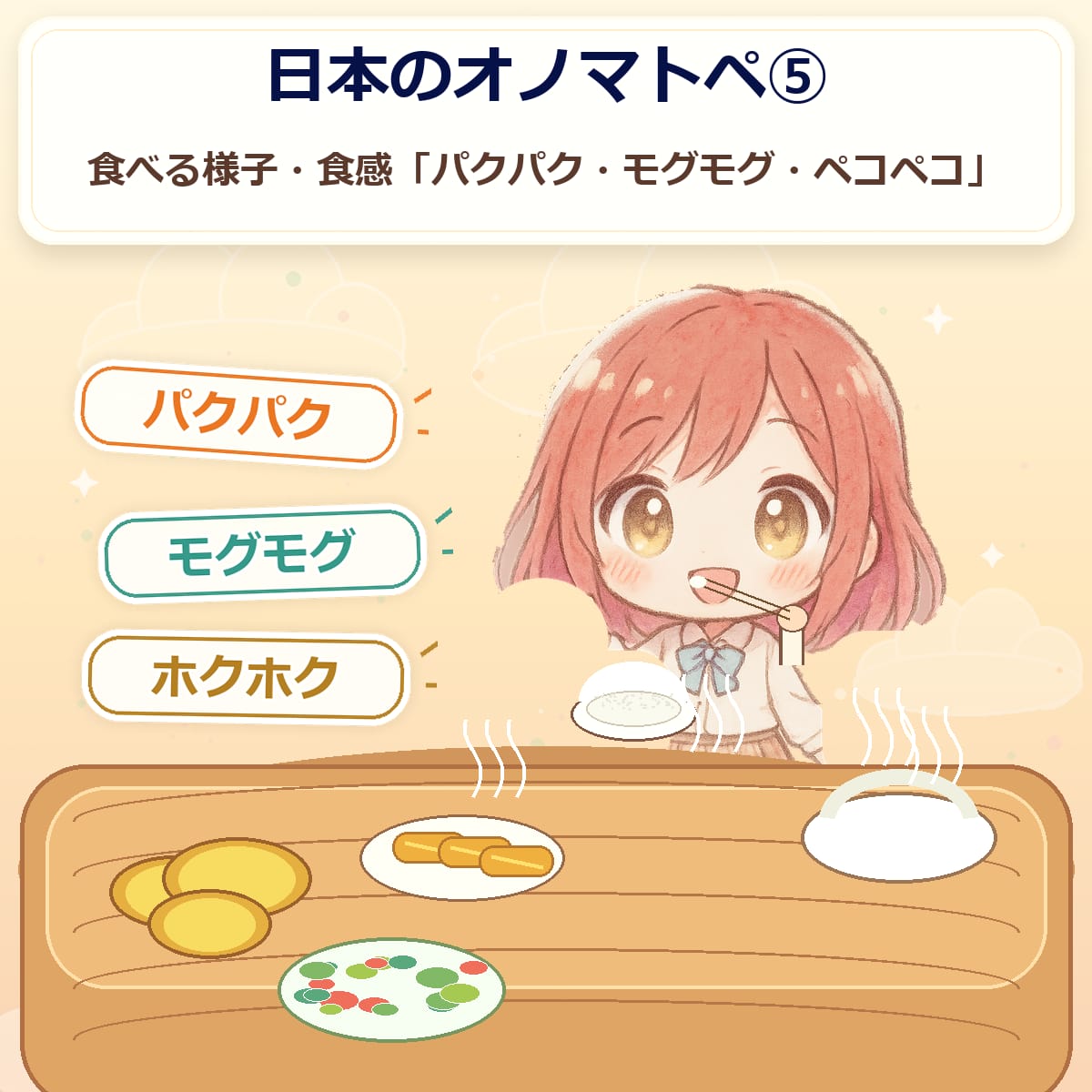
These are words that put eating and drinking, and the food texture called 「食感(しょっかん) [ɕo̞kkaɴ]」, into language.
Meals happen every day, so these onomatopoeic words appear very often in conversation. You will hear and see them in restaurants, at home, on social media, and in manga. If you learn them today, talking about meals in Japanese will sound much more natural.
Today, we will learn eight onomatopoeic words for eating, drinking, and food texture, with examples showing what kind of situation they express and how to use them.
Japanese onomatopoeia has two main types. Let's review them from the previous articles.
| Type | What it expresses | Examples |
|---|---|---|
| 「擬音語(ぎおんご) [ɡʲio̞ɴɡo̞]」: words that turn sounds into language | Sounds you can actually hear | 「ザーザー(雨の音)」 (sound of heavy rain), 「ゴクゴク(飲む音)」 (sound of drinking in big gulps) |
| 「擬態語(ぎたいご) [ɡʲitaiɡo̞]」: words that turn states into language | States, feelings, and food texture without sound | 「パクパク(食べる様子)」 (eating eagerly), 「ペコペコ(空腹の様子)」 (being very hungry) |
Onomatopoeia for eating and drinking includes both types.
You do not need to separate them perfectly. If you pay attention to whether a sound can be heard or a state is being described, the meanings become easier to remember.
First, let's look at the list. The first half describes ways of eating or drinking, and the second half describes food texture.
| Word | Group | In one short phrase |
|---|---|---|
| 「パクパク」 | way of eating | opening the mouth and eating well |
| 「モグモグ」 | way of eating | chewing well with the mouth closed |
| 「ガツガツ」 | way of eating | eating forcefully and eagerly |
| 「ゴクゴク」 | way of drinking | drinking quickly in big gulps |
| 「ペコペコ」 | stomach state | being very hungry |
| 「サクサク」 | food texture | light and pleasantly crisp |
| 「シャキシャキ」 | food texture | fresh vegetables with a crisp bite |
| 「ホクホク」 | food texture | warm and soft |
Now let's look at each one in more detail.
Meaning: Eating well while opening and closing the mouth. It is used when someone eats a lot and seems to enjoy it.
It fits when someone has a good appetite or when the food is so good that they keep eating.
Examples:
Usage hint: 「パクパク」 has a bright and energetic image. It is often used together with a positive feeling, such as "They are eating well" or "That looks delicious."
Meaning: Chewing food slowly and well with the mouth closed. It shows that food is inside the mouth.
Use it when someone is chewing slowly or when their mouth is full.
Examples:
Difference from 「パクパク」: 「パクパク」 shows food being put into the mouth one bite after another. 「モグモグ」 shows food being chewed inside the mouth. They describe different moments in eating.
Meaning: Eating forcefully because you are hungry, without holding back. It gives the feeling that appetite is stronger than manners.
Use it when someone is very hungry or eating quickly.
Examples:
Caution: 「ガツガツ」 can sound a little ill-mannered. Be careful when saying it directly to another person. When you use it about yourself, it can sound humorous in the right situation.
Meaning: Drinking a lot quickly and with energy. It also includes the sound heard from the throat, like 「ゴクッ」.
It fits when you are thirsty or when you drink a cold beverage all at once.
Examples:
Usage hint: 「ゴクゴク」 is close to 「擬音語」 because it is a word for a drinking sound you can hear. If you say 「ゴクッ」 once, it describes one gulp, as in 「水をゴクッと飲んだ。」 (I took one gulp of water.)
Meaning: Being hungry. It is often used in the form 「おなかがペコペコ」.
This is a very useful word before a meal or when you have not eaten for a long time.
Examples:
Caution: 「ペコペコ」 has one more meaning. It can describe bowing the head again and again, as in 「店長にペコペコする。」 (to bow repeatedly to the manager). When talking about food, it is 「おなかがペコペコ」. When talking about bowing, it is 「人にペコペコ」. The words that come with it are different.
Meaning: A light sound and pleasant bite when you chew something. It is not too hard and feels good to bite.
Use it for 「てんぷら(てんぷら) [te̞mpɯɾa]」, battered and fried seafood or vegetables, cookies, fried foods, and fresh vegetables.
Examples:
Usage hint: 「サクサク」 can also be used for things other than food. In a sentence like 「仕事がサクサク進む。」 (work moves along smoothly), it describes something moving forward quickly and pleasantly.
Meaning: A light, clear bite when you chew fresh vegetables and similar foods. It feels juicy and pleasant.
Use it for fresh vegetables and fruits such as lettuce, cucumbers, apples, and bean sprouts.
Examples:
Difference from 「サクサク」: 「サクサク」 is a dry, light texture, as with cookies. 「シャキシャキ」 is the texture of juicy vegetables. Both feel good to bite, but the amount of moisture is different.
Meaning: A warm, soft, moderately dry texture. It gives the feeling of warmth spreading in the mouth.
Use it for potatoes, sweet potatoes, pumpkins, and roasted sweet potatoes.
Examples:
Usage hint: In addition to food texture, 「ホクホク」 can also express a happy feeling, as in 「おこづかいをもらってホクホク顔だ。」 (having a pleased face after receiving spending money). It has the image of warmth and satisfaction.
| Form | Examples | Explanation |
|---|---|---|
| Repeat the same sound twice | 「パクパク」、「モグモグ」、「サクサク」 | The most common form. It gives the image that the action or texture continues. |
| Add 「〜と」 to connect to a verb | 「ゴクゴクと飲む」、「サクサクとかむ」 | Natural when explaining the manner in detail. |
| Add 「〜する」 to make a verb | 「モグモグする」、「ペコペコする」 | Expresses a movement or state. |
| Use 「〜だ/〜している」 to describe a state | 「おなかがペコペコだ」、「サクサクしている」 | Communicates texture or condition. |
| Say it only once | 「ゴクッと飲む」、「パクッと食べる」 | Shows a single action. |
Onomatopoeia for eating and texture is very useful for briefly describing deliciousness and how someone eats. Even without a long explanation, the situation comes across right away.
Compared with only saying "ate" or "delicious," these words also communicate how the food was eaten or what the texture was like. They are often used in meal conversations with family and friends.
Food texture onomatopoeia is very common when introducing food. You will see it on restaurant menus, social media posts, and food reviews.
When texture words are included, readers can imagine the taste more easily. Using them when introducing food helps the deliciousness come across clearly.
| Word | Situation | Easily confused word | Difference |
|---|---|---|---|
| 「パクパク」 | eating one bite after another | 「モグモグ」 | 「モグモグ」 is chewing inside the mouth |
| 「ガツガツ」 | eating forcefully | 「パクパク」 | 「ガツガツ」 can sound ill-mannered |
| 「サクサク」 | dry, light texture | 「シャキシャキ」 | 「シャキシャキ」 is for juicy vegetables |
| 「シャキシャキ」 | vegetable bite | 「ホクホク」 | 「ホクホク」 is warm and soft |
| 「ペコペコ(おなか)」 | hunger | 「ペコペコ(頭を下げる)」 | The words that come with it are different |
| Fits | Does not fit |
|---|---|
| Meal conversations with friends and family | Public documents and reports, especially if overused |
| Introducing dishes or restaurants | Academic papers and formal notices |
| Writing food impressions on social media | Formal business meeting minutes |
| Talking about children or animals eating | Formal self-introductions with people you have just met |
| Word | What kind of situation? | Example | Reading(「かな(ひらがなよみ)」) | Pronunciation (IPA) | Usage point |
|---|---|---|---|---|---|
| 「パクパク」 | eating well | 「ごはんをパクパク食べる。」 (I eat rice eagerly.) | (ぱくぱく) | [pakɯ̥pakɯ̥] | Bright, energetic eating |
| 「モグモグ」 | chewing with the mouth closed | 「口の中でモグモグする。」 (I chew with food in my mouth.) | (もぐもぐ) | [mo̞ɡɯmo̞ɡɯ] | The act of chewing |
| 「ガツガツ」 | eating forcefully | 「ガツガツ食べる。」 (I eat ravenously.) | (がつがつ) | [ɡatsɯ̥ɡatsɯ̥] | Can sound ill-mannered |
| 「ゴクゴク」 | drinking quickly in big gulps | 「水をゴクゴク飲む。」 (I drink water in big gulps.) | (ごくごく) | [ɡo̞kɯ̥ɡo̞kɯ̥] | A drinking sound can be heard |
| 「ペコペコ」 | being hungry | 「おなかがペコペコだ。」 (I am very hungry.) | (ぺこぺこ) | [pe̞ko̞pe̞ko̞] | A state of hunger |
| 「サクサク」 | light and pleasantly crisp | 「クッキーがサクサクだ。」 (The cookie is crisp.) | (さくさく) | [sakɯ̥sakɯ̥] | Dry, light texture |
| 「シャキシャキ」 | crisp vegetable texture | 「レタスがシャキシャキだ。」 (The lettuce is crisp and fresh.) | (しゃきしゃき) | [ɕakiɕaki] | Juicy texture |
| 「ホクホク」 | warm and soft | 「いもがホクホクだ。」 (The potato is warm and soft.) | (ほくほく) | [ho̞kɯ̥ho̞kɯ̥] | Warm satisfaction |
IPA is approximate. Vowel length and sounds such as 「く」 and 「つ」 vary by speaker and region. Check them together with kana.
| Scene | Intention | Natural wording | Reading(「かな(ひらがなよみ)」) | Pronunciation (IPA) | Point |
|---|---|---|---|---|---|
| Daily life (meal) | Someone ate well | 「子どもがパクパク食べたよ。」 (The child ate eagerly.) | (こども が ぱくぱく たべた よ) | [ko̞do̞mo̞ ɡa pakɯ̥pakɯ̥ tabe̞ta jo̞] | A bright way of eating |
| Daily life (hunger) | You are hungry | 「おなかがペコペコだよ。」 (I am very hungry.) | (おなか が ぺこぺこ だ よ) | [o̞naka ɡa pe̞ko̞pe̞ko̞ da jo̞] | Often used before a meal |
| Daily life (drink) | You drank all at once | 「水をゴクゴク飲んだ。」 (I drank water in big gulps.) | (みず を ごくごく のんだ) | [midzɯ o̞ ɡo̞kɯ̥ɡo̞kɯ̥ no̞nda] | When you are thirsty |
| Shop (introduction) | You want to describe texture | 「外はサクサクしています。」 (The outside is crisp.) | (そと わ さくさく して います) | [so̞to̞ wa sakɯ̥sakɯ̥ ɕite̞ imasɯ̥] | Introducing a dish |
| Social media (impression) | You want to express freshness | 「野菜がシャキシャキでした。」 (The vegetables were crisp and fresh.) | (やさい が しゃきしゃき でした) | [jasai ɡa ɕakiɕaki de̞ɕita] | Juicy texture |
| Work (softly) | You want someone to eat slowly | 「よくモグモグかんでくださいね。」 (Please chew well.) | (よく もぐもぐ かんで ください ね) | [jo̞kɯ̥ mo̞ɡɯmo̞ɡɯ kande̞ kɯdasai ne̞] | A gentle prompt |
Onomatopoeia for eating and texture can be written in both hiragana and katakana.
The meaning is the same. Choose based on the situation and the feeling you want to give. Restaurant menus often use katakana.
Today's words become easier to organize when you divide them into two groups.
| Group | Words |
|---|---|
| Ways of eating and drinking (actions) | 「パクパク」、「モグモグ」、「ガツガツ」、「ゴクゴク」 |
| Food texture | 「サクサク」、「シャキシャキ」、「ホクホク」 |
| Stomach state | 「ペコペコ」 |
Onomatopoeia for eating and texture communicates not only the situation, but also feeling.
If you choose the word by imagining the feeling, it becomes easier to find the right one.
| Common sentence | What is the issue? | Fix (example) |
|---|---|---|
| 「クッキーがシャキシャキでおいしい。」 | 「シャキシャキ」 is for vegetable-like texture | 「クッキーがサクサクでおいしい。」 |
| 「水をパクパク飲んだ。」 | 「パクパク」 describes eating | 「水をゴクゴク飲んだ。」 |
| 「おなかがサクサクだ。」 | Hunger is 「ペコペコ」 | 「おなかがペコペコだ。」 |
| 「やきいもがシャキシャキだ。」 | Sweet potatoes are warm and soft | 「やきいもがホクホクだ。」 |
Onomatopoeia for eating and food texture becomes easier to learn when you group it by type:
The four key points are:
Once you can use onomatopoeia for eating and texture, you can talk about meals vividly in Japanese. Start with common words such as 「パクパク」 and 「ペコペコ」, and try using them in your next meal situation.
Next time, in Japanese Onomatopoeia ⑥, we will cover onomatopoeia that describes feelings and states in more detail. We will look at expressions that put people's inner feelings into words, such as 「イライラ(おこっている)」 (irritated), 「ソワソワ(落ち着かない)」 (restless), and 「ニコニコ(うれしそう)」 (smiling happily). Please look forward to it.